The Notorious Bettie Page: The Reason Your Grandfather Kept the Garage Door Locked
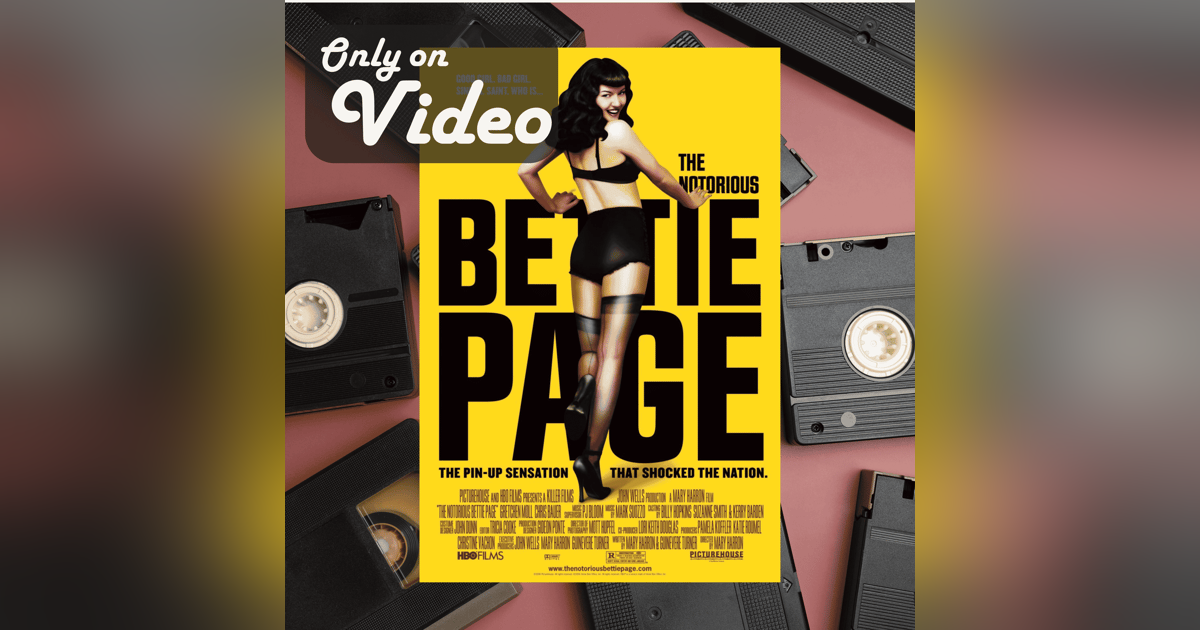
In Episode 3 of Only On Video (Mary Harron Season), I cover The Notorious Bettie Page—Harron and Guinevere Turner’s tonal left-turn after American Psycho. Instead of a satire about a narcissistic killer, this one follows a woman who becomes a cultural flashpoint simply for existing publicly in her own body.
But, Bettie isn’t a rebel or a provocateur.
She’s an “unintentional revolutionary”: cheerful, sincere, religious, and—by the standards of mid-century America—dangerously unashamed. The film’s central tension isn’t Bettie versus herself. It’s Bettie versus a society that worships her in private and condemns her in public.
In This Episode
Context: Release, Reception, and the Cultural Moment
- Premiered at TIFF (2005), U.S. release (April 2006)
- A mid-2000s culture split: nostalgia for “old America” alongside renewed debates about censorship, sexual agency, and patriarchy
- Bettie’s rediscovery in the 80s and revival in the 90s/early 2000s (fashion, pop culture, pin-up aesthetics)
- Why the film didn’t hit as a box-office “moment” despite Page’s renewed visibility
Historical Frame: Post-War Moral Panic
- 1950s America, Red Scare-era anxiety, and the “war on obscenity”
- A national panic where men hold the microphone: government, church, and institutions defining “corruption”
- The film’s recurring hypocrisy: the same culture that profits from desire punishes women for being desirable
Director’s Context: Harron and Turner’s “Unintentional Revolutionary”
- Harron’s third feature and her second collaboration with Guinevere Turner
- The long development history (work began in the early 1990s)
- Harron’s fascination with Bettie’s contradictions: nude without shame, devout without irony
- The visual idea: black-and-white vintage Americana shifting to color as Bettie finds freer ground
Why This Film Belongs in This Season
- Same core Harron themes: power, gender, control, hypocrisy, and cultural punishment
- A clean contrast with American Psycho: Bateman hides behind perfection; Bettie refuses to hide at all
- The story is not cynical—Bettie is neither villain nor cautionary tale, just a likable person navigating a society built to shame her
Cast & Crew Breakdown
Behind the Camera
- Mary Harron + Guinevere Turner: the same team as American Psycho, but with a warmer, more curious tone
- Cinematography by Maysie Hoy:
- Black-and-white as a direct echo of vintage pin-up photography
- Color in Miami as a visual marker of space, freedom, and ease
- Score by Mark Suozzo:
- Period-adjacent, light, jazzy, supportive without pushing the film into melodrama
- HBO Films backing: more polish, but still intimate and character-focused
In Front of the Camera
- Gretchen Mol as Bettie Page:
- Radiant, sincere, and strangely untouched by the moral noise around her
- A “comeback” lead performance that carries the movie’s tonal balancing act
- Lili Taylor as Paula Klaw:
- Pragmatic and protective, grounding Bettie within the pin-up world
- Chris Bauer as Irving Klaw:
- Opportunistic but not cartoonish; a businessman with limits
- David Strathairn as Senator Estes Kefauver:
- Quiet menace as the face of institutional control
- Returning Harron collaborators (Jared Harris, Cara Seymour, others) adding continuity across wildly different films
Story Highlights (Spoilers)
Act I: Innocence and Constraint
- Nashville upbringing, strict religious framework, and implied early trauma
- Marriage, violence, and the first quiet act of defiance: leaving
- New York as escape, reset, and search for control
Act II: Discovery and Contradiction
- Modeling begins as playful and almost innocent—joyful rather than “scandalous”
- “Men’s photography clubs,” obscenity laws, and the Klaws introducing fetish/bondage work
- The surprising tone of the fetish scenes: not lurid, not exploitative, often upbeat
- A defining contradiction the film leans into:
- “I believe in Jesus,” delivered while in bondage gear
- Bettie’s worldview: talent is a gift from God, and she’s using hers
Act III: Exposure and “Redemption”
- Miami shift into color and a new sense of ease
- The home-front hypocrisy: family judgment paired with private keeping of her images
- The Senate investigation tightening—and Bettie never being allowed to speak for herself
- The film’s closing statement on shame:
- “I’m not ashamed… Adam and Eve were naked… when they sinned, they put on clothes.”
Lowlights and Highlights
Lowlights
- Pacing: at 90 minutes, it can still feel slow, with tension arriving late
- Limited emotional range: Bettie’s internal drive remains deliberately opaque, sometimes to the film’s detriment
- Stylization: black-and-white-to-color is effective, but can feel blunt or “conceptual”
- A neat ending: faith-as-closure feels tidier than the ambiguity you might expect after Harron’s earlier films
- Underplayed legacy: the film ends before Bettie’s second life as a pop-culture icon fully emerges
Highlights
- The social critique: men commit real harm with little consequence while Bettie’s body becomes the “national crisis”
- Gretchen Mol’s performance: upbeat, human, and difficult to pull off without making the movie feel naïve or preachy
- A distinctly Harron strength: observing contradictions without forcing a single “lesson”
- Bettie as a genuinely likable protagonist in a world determined to moralize her—without turning her into a saint or a rebel caricature
Funny / Striking Moments From the Episode
- The film’s best encapsulation of its tone: Bettie defending nudity through Genesis while embodying the very thing the era labels “obscene”
- The underlying joke the movie never states outright: America panics about corsets and photos while ignoring actual violence and exploitation around her
- The visual punchline of hypocrisy: public condemnation, private收藏 (kept images), and institutional men “speaking for” Bettie while never meeting her
Legacy
- In Harron’s career: a “palette cleanser” after the brutality of American Psycho—still sharp, but more forgiving
- A completion of an early Harron trilogy of cultural punishment:
- Valerie Solanas, Patrick Bateman, Bettie Page—each extreme in a different direction, each punished by society’s rules
- In pop culture: even without box-office impact, the film re-humanizes Bettie for mainstream audiences during her modern revival
- A reminder of the film’s core idea: the things that got Bettie condemned in the 1950s became mass-market fantasy decades later
Next Up
Next episode: The Moth Diaries (2011)—Harron’s gothic boarding-school horror about identity, repression, and shifting power dynamics.
Follow the show, leave a rating and review, and share Only On Video with someone who likes director-focused deep dives.
Listen to more episodes at https://onlyonvideo.com