Daliland: Mary Harron’s Portrait of Salvador Dalí
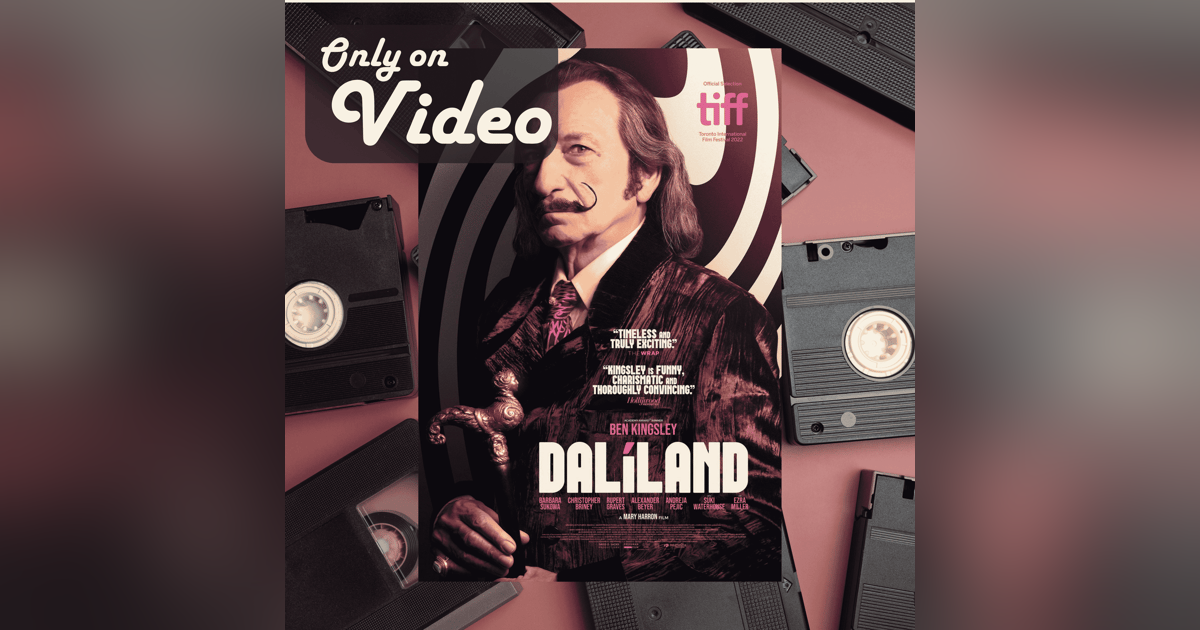
In the Season 1 finale of Only On Video, I close things out with Dalíland—Mary Harron’s most recent feature, and a return to the art world after I Shot Andy Warhol. This time, though, we’re not watching an artist rise. We’re watching what happens when the persona becomes the whole machine—when art, ego, commerce, and self-parody blur into one continuous performance.
Daliland is an above-average, often magnetic biopic anchored by Ben Kingsley and Barbara Sukowa, with a vivid 1970s art-scene atmosphere. It’s also looser and less urgent than its ingredients suggest, and it sometimes feels unsure whether it wants to be an art-market thriller, a relationship study, or a character portrait of decline.
What This Episode Covers
Context
- Premiered at TIFF (September 2022), released theatrically in 2023, modest box office
- Mixed critical response, with standout praise for Kingsley and Sukowa
- Why this film works as a bookend to the season: Harron back in “artist mythology,” but at the end of the arc instead of the beginning
Historical Frame
- Mid-1970s: Dalí as a celebrity icon more than a surrealist innovator
- Prints, editions, authenticity, and “Dalí-as-currency” in a changing art market
- The film’s core idea: not decline as tragedy, but genius wrestling with aging and the inability to stop performing
Director Context
- Co-written with John C. Walsh
- A notable structural choice: the story filtered through James, a young assistant and witness, rather than being fully inside Dalí’s head
- How it completes an informal Harron arc of artists living inside myth (I Shot Andy Warhol → Bettie Page → Dalíland)
Cast and Crew Breakdown
Behind the Camera
- Cinematography: glossy 1970s glamour, hotel-suite intimacy, handheld energy (effective for closeness, sometimes distracting)
- Score/soundtrack: Spanish/classical textures mixed with 70s rock and entourage chaos; music used as personality, not wallpaper
In Front of the Camera
- Ben Kingsley as Salvador Dalí: theatrical, hilarious, insecure, fragile—often in the same scene
- Barbara Sukowa as Gala: muse/manager/martyr; sustaining Dalí while being trapped by him
- Christopher Briney as James: audience proxy and observer; useful lens, limited personal arc
- Andreja Pejić as Amanda Lear: a deliberate casting choice that complements Lear’s real-life mystique and ambiguity
- Supporting appearances that reinforce Dalí’s orbit: Alice Cooper, Jeff Fenholt, and Ezra Miller as young Dalí in flashbacks
Story Highlights
Act I: New York — Celebrity Genius as Routine
- Dalí living at the St. Regis, surrounded by hangers-on and controlled chaos
- James gets pulled into Dalí’s world and starts to feel like he “belongs” on this other planet
- Dalí’s persona as currency: signatures, spectacle, and the performance of being “Dalí”
- The check-signing gag as thesis: Dalí turns even paying a bill into art (and a dodge)
The New York Show: The Myth Slips
- The exhibition underwhelms; the comeback doesn’t materialize
- Dalí and Gala fracture publicly; James is fired from the gallery job
- The story pivots to Europe and the darker mechanics behind the legend
Act II: Spain — Forgery, Dependence, and the Weight of Aging
- Prints/lithographs authenticity subplot: Dalí signing ahead of production, money moving, truth getting blurry
- Gala’s fortress life and her lover; the marriage as mutual dependence, not romance
- Flashbacks to young Dalí/Gala: how she provided structure and confidence—how the myth was built
- James confronts the fraud; Dalí retreats into self-deception because myth is survival
Epilogue: 1985 — The Persona’s Afterimage
- Years later, post-fire injury and post-Gala, James returns a signature book
- Dalí flips through the many versions of himself—an ending that quietly reinforces the film’s obsession with identity-as-performance
Funny / Interesting Facts and Moments
- The restaurant check signature: “When Dalí signs, they do not cash it. They frame it.” A perfect micro-scene for Dalí’s blend of genius, ego, and financial gamesmanship.
- Alice Cooper’s real-life Dalí connection: the film’s hologram collaboration isn’t random—Dalí and Cooper actually did cross paths creatively in the 1970s.
- Amanda Lear casting: Harron’s choice to cast Andreja Pejić reads like an intentional nod to Lear’s self-created ambiguity and public mythmaking.
- Dalí’s pre-signing practice: the film’s fraud subplot ties into long-running debates about late-career Dalí prints and authenticity.
- Surrealism as legacy, not trend: the movie doesn’t lecture on surrealism, but it quietly shows Dalí living in a world where the “movement” has passed and only the “name” remains.
Highs and Lows
Lowlights
- The narrative lacks urgency despite inherently high-stakes material (fraud, collapsing career, volatile marriage)
- Handheld camerawork can feel mismatched with the material’s visual precision
- Flashbacks are thematically necessary but often too thin to fully land
- James works as a witness, but his subplot threads feel underdeveloped
- The film sometimes wobbles between genres (thriller vs. character study vs. relationship portrait)
Highlights
- Kingsley’s performance is the engine: funny, exhausting, heartbreaking, and human
- Sukowa’s Gala: the clearest emotional counterweight and the film’s structural spine
- A strong sense of time/place/orbit: parties, hotel suites, entourage energy that feels lived-in, not nostalgic
- Effective tonal transitions between New York’s manic performance and Spain’s private unraveling
- The film’s central insight: the burden of constant performance, and the cost of keeping the myth alive
Legacy and Season Wrap
- Dalíland isn’t a career-defining Harron film, but it’s a useful refinement of her long-running interests: complicated figures, public myth versus private vulnerability, and identity as something constructed and maintained.
- It also caps Season 1 with a clear through-line: Harron’s fascination with outsiders, icons, and cultural misfits—and the ways fame and power distort everyone around them.
If you’ve enjoyed Season 1 of Only On Video, subscribe so you don’t miss the next season, and share the show with a film nerd in your life.
Listen to all episodes and find updates at https://onlyonvideo.com.